
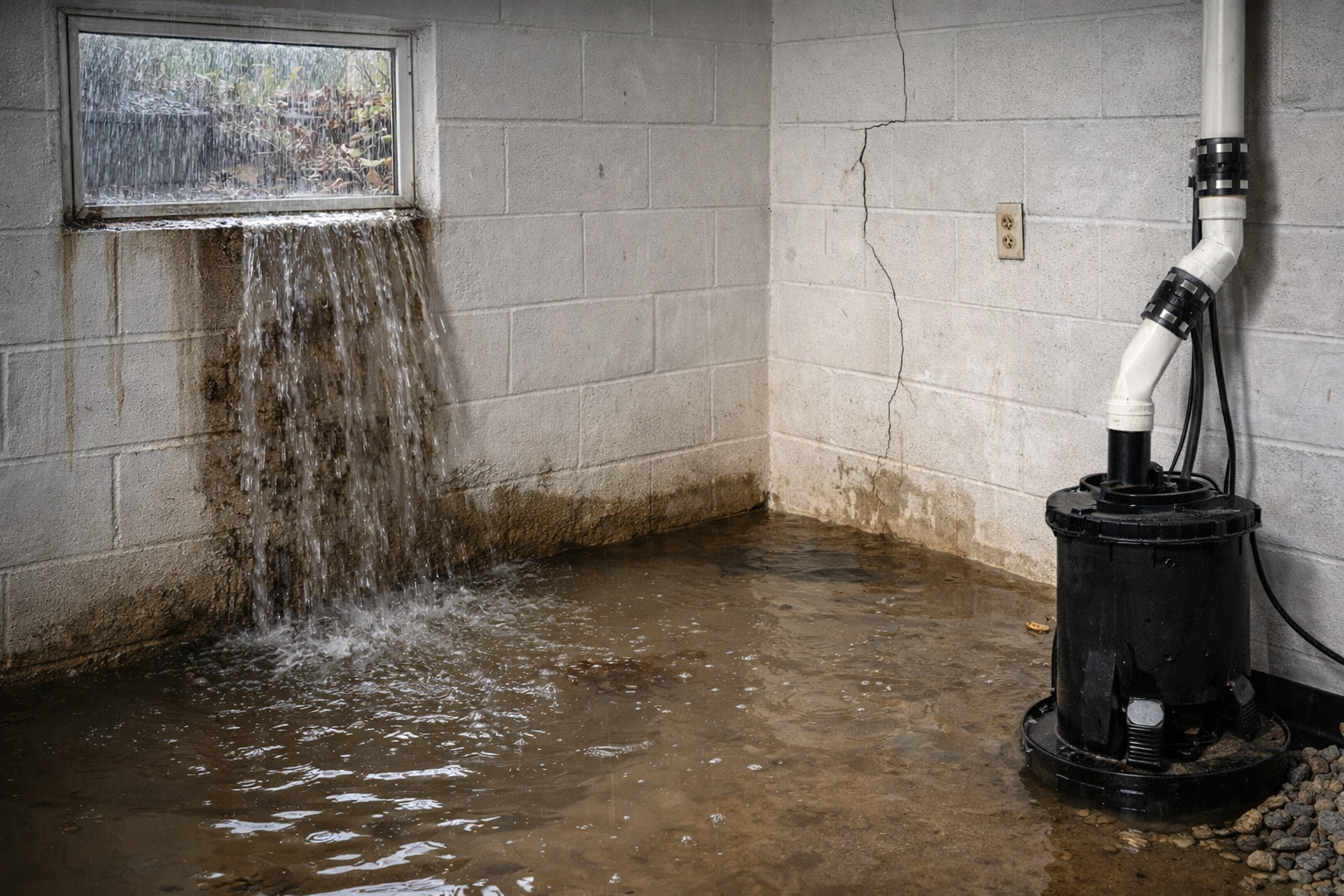
Water in basement after heavy rain is one of the most common calls we get across Connecticut, and it almost always follows the same pattern. The storm passes, you head downstairs, and you find a puddle in the corner, a damp wall, a wet line along the floor, or a musty smell that wasn’t there yesterday. Sometimes it dries up in a few days. Then the next big rain brings it back.
The most important thing to know is that water leaking into basement after heavy rain always has a source. Once you find that source, the right waterproofing plan can protect the space and keep the same problem from coming back.
This guide explains why water gets in during storms, the specific causes we see most in Connecticut homes, what to do the moment you find it, why quick fixes usually fail, and when to bring in a professional. Premier Basement Solutions & Remodeling helps Connecticut homeowners identify basement water problems and build custom waterproofing solutions using drainage systems, sump pumps, foundation crack repair, crawl space encapsulation, and moisture-control methods designed around the home.
Why Does My Basement Leak When It Rains?
Basements sit below ground level, surrounded by soil that absorbs and holds water. During heavy rain, that soil becomes saturated. Water in saturated soil pushes against the foundation from every side, and that force has a name: hydrostatic pressure. The more water the ground holds, the harder it pushes.
Concrete and block foundations are strong, but they are not waterproof. Under enough pressure, water finds the easiest path inside: a hairline crack, the joint where the floor meets the wall, a gap around a pipe, a window well that fills faster than it drains. Even a tiny opening will let water through when the ground outside is holding more moisture than it can drain away.
That is why water in basement after heavy rain is rarely a one-time event. Water seeping into basement after heavy rain exposes a weakness that was already there. Until someone addresses that weakness, every big storm will find it again.
The Causes Connecticut Homeowners See Most
Water enters basements for a short list of reasons. Most wet basements have more than one.
Hydrostatic Pressure at the Floor-Wall Joint
The seam where the basement floor meets the wall, often called the cove joint, is the weakest point in most foundations. When groundwater rises, it pushes up and in through this joint first. If you see water along the edge of the floor after a storm with no visible crack, this is usually the cause. Interior drainage systems exist specifically to catch water at this joint.
Foundation Cracks
Foundation cracks are one of the most common entry points. Some cracks only leak during heavy rain, while others show stains, dampness, or active seepage more often. Vertical cracks in poured concrete often come from shrinkage and settling. Horizontal or stair-step cracks in block walls can signal pressure from outside and deserve a closer look. Cracks should not wait just because they look small. Saturated soil will push water through openings you can barely see.
Clogged or Failed Footing Drains
Many Connecticut homes built from the 1950s onward have footing drains (perimeter drain tile) around the base of the foundation. Over decades these clog with silt and roots or collapse entirely. When the footing drain stops working, the water it used to carry away sits against the foundation instead.
Window Wells and Bulkheads
A window well without a working drain becomes a bucket during heavy rain. Once it fills, water pours in around the window frame. Bulkhead doors have the same problem when the seal fails or the stairwell drain clogs.
Grading and Downspouts
Some of the water pushing on your foundation started on your roof. A single downspout can dump hundreds of gallons at the base of the wall during a storm. Downspouts that discharge next to the foundation, and yards that slope toward the house instead of away from it, feed the problem directly.
Sump Pump Problems
A sump pump that is old, undersized, stuck, or without a battery backup will fail during exactly the storm you need it for. Power outages during Connecticut nor’easters and summer thunderstorms are a common reason a basement that stayed dry for years suddenly floods.
Pipe Penetrations and Utility Openings
Water lines, sewer lines, and electrical conduits all pass through the foundation. The seal around each one breaks down over time and becomes a direct channel for groundwater.
Why Connecticut Basements Get Hit Harder
A few local conditions make basement leaks in heavy rain more common here than in many parts of the country.
Much of central Connecticut sits on clay-heavy soil that drains slowly and holds water against foundations long after the rain stops. Spring thaw adds snowmelt on top of rain, which is why March and April produce more wet basement calls than any other months. Nor’easters and tropical storm remnants drop several inches in a day, overwhelming footing drains and sump pumps sized for normal rainfall. And a large share of homes in Hartford County and the Connecticut River valley are 50 to 100 years old, with original drainage that has long since stopped working.
None of this means a Connecticut basement has to leak. It means the waterproofing plan has to account for the conditions the house actually lives in.
Common Signs of a Basement Water Problem
Not every basement water issue looks like flooding. Some signs are subtle, especially early on. You may have a moisture problem if you notice:
- Water on the basement floor after storms
- Damp concrete walls or a dark line along the floor edge
- Musty basement odors
- Water stains near the floor
- Peeling paint or damaged finishes
- White powder or residue on basement walls (efflorescence, which means water has moved through the concrete)
- Visible foundation cracks
- High humidity
- A sump pump that runs constantly
- Moisture around the floor-wall joint
- Wet boxes, flooring, or stored items
- Mold or mildew concerns
Even if the water dries up, the issue still needs an inspection. A dry floor after a few days does not mean the source has gone away.
What to Do Right Now About Water in Basement After Heavy Rain
If you find water in basement after heavy rain, protect the space first, then document what you see. The same steps apply to any water in basement from rain, whether it is a puddle or a wet wall.
- Cut power to affected outlets if water is near them, and do not plug in electronics on a damp floor.
- Move stored items off the floor and away from wet walls.
- Take photos of the water, stains, cracks, and wet areas before anything dries. Note where the water appeared first and how far it spread.
- Check the sump pump. Is it running? Is the pit full? Is the discharge line clear outside?
- Look for visible cracks and note whether water is coming from a crack, the floor joint, a window, or a pipe.
- Remove standing water with a wet vac and run a dehumidifier to limit mold growth.
- Do not cover the problem with new flooring, paint, or finishes.
These details help a waterproofing professional understand how water is entering and what solution the basement actually needs.
Why Quick Fixes Usually Do Not Hold
Homeowners often try waterproof paint, hydraulic cement in a crack, or a bigger sump pump before calling anyone. These sometimes help for a season. They rarely solve the problem, because they treat the symptom and not the pressure behind it.
Waterproof paint peels once hydrostatic pressure pushes water through the wall behind it. Surface patching seals the crack you can see while water finds the next one. A bigger pump only helps if water is reaching the pit; it does nothing for water coming through walls or cracks across the room. We covered this in more detail in why DIY basement sealing and waterproofing may not be the best option.
Why a Sump Pump Alone May Not Solve the Problem
A sump pump is an important part of many basement waterproofing systems, but it is not always the whole solution.
If water enters through cracks, wall joints, or multiple areas of the basement, the pump only handles the water that reaches the pit. If the drainage system feeding the pit is incomplete, clogged, poorly placed, or missing, water still collects on the floor or seeps through walls.
A pump also struggles when it is old, undersized, running constantly, lacks a battery backup, or is not connected to a proper drainage system. In many homes the pump is working hard because the basement has a larger water management problem.
That is why Premier Basement Solutions looks at the full basement, not just the pump. A reliable solution may combine drainage, sump pump replacement, foundation crack repair, and crawl space moisture control.
How Professionals Stop Basement Leaks in Heavy Rain
Every basement is different, but a lasting fix usually draws on a few proven components.
Interior drainage systems run along the floor-wall joint, collect water where it enters, and carry it to the sump pit before it spreads. This is the most effective answer for water at the cove joint and for groundwater pressure.
Sump pump installation or replacement sizes the pump to the home, adds a battery backup for outages, and routes the discharge well away from the foundation.
Foundation crack repair seals active cracks from the inside, usually with urethane or epoxy injection, so water loses that entry point. Visit our foundation repair page for more on how we handle cracks.
Crawl space encapsulation seals crawl spaces that share moisture with the basement. If your basement smells musty or feels humid after rain, the crawl space may be part of the issue.
Exterior fixes such as extending downspouts, regrading, and clearing window well drains reduce how much water reaches the foundation in the first place.
Our basement waterproofing in Connecticut page explains each of these systems and how we match them to a home.
Do Not Finish a Basement Before Fixing Water Problems
If you are planning to remodel or finish your basement, waterproofing comes first.
Installing flooring, drywall, paint, trim, lighting, or a bathroom before solving water issues leads to expensive damage later. Moisture behind walls or under flooring creates odors, staining, mold concerns, and repairs that could have been avoided.
Premier Basement Solutions addresses waterproofing first, then supports basement remodeling and electrical work once the basement is ready. That makes the process simpler for homeowners who want a dry, finished, usable space.
When to Call a Basement Waterproofing Contractor
Call a basement waterproofing contractor if water appears after rain more than once, if your basement smells musty, or if you see cracks, stains, damp walls, or sump pump problems. Schedule an inspection even if you are not sure where the water is coming from. Guessing leads to temporary fixes that miss the real issue.
A professional inspection answers the questions that matter:
- Where is the water entering?
- Is the sump pump working properly and sized correctly?
- Does the basement need a drainage system?
- Are foundation cracks contributing?
- Is crawl space moisture affecting the home?
- Can the basement be safely finished later?
The earlier the problem gets attention, the easier it is to protect the basement.
Frequently Asked Questions
Why Connecticut Homeowners Choose Premier Basement Solutions
Premier Basement Solutions & Remodeling is a family-owned and operated company based in Rocky Hill, CT. Our team helps Connecticut homeowners with basement waterproofing, custom drainage systems, sump pump installation and replacement, foundation crack repair, crawl space encapsulation, basement remodeling, and electrical services.
Homeowners choose Premier because we focus on clear communication, custom solutions, and practical recommendations. Every basement is different, so our team looks at the full picture before recommending a repair.
With over 75 years of combined expertise, Premier brings waterproofing, construction, remodeling, foundation, and electrical knowledge together under one team. That matters when the goal is not just to remove water, but to protect the basement long-term.
Get Help With Water in Basement After Heavy Rain
If you are seeing water in the basement after heavy rain, do not wait for the next storm to confirm the problem. Start with a clear plan.
Premier Basement Solutions provides basement waterproofing, wet basement repair, drainage systems, sump pump installation, foundation crack repair, and crawl space moisture solutions for homeowners in Rocky Hill and throughout Connecticut.
Schedule your free basement waterproofing quote today.